Omega-3 in Midlife: Chia Seeds, Fish, and What Women Need to Know
Why plant omega-3 and fish omega-3 are not quite the same — and how to choose wisely for brain, heart, and metabolic health.
Chia pudding has become a modern health favourite, often topped with berries, fruit, nuts, coconut, or chocolate. One of the reasons chia seeds are so often celebrated is their omega-3 content.
But does eating chia seeds give us the same omega-3 benefits as eating salmon, sardines, or taking fish oil?
The answer is: not quite. And that is where it becomes interesting.
Chia seeds are nutritious, fibre-rich, contain omega-3, and are absolutely worth keeping on the menu. But when it comes to omega-3, there is an important difference between plant sources and marine sources — and this detail matters particularly in midlife.
Before we compare chia seeds and fish, let’s first understand what omega-3 is and why it is relevant for us.
Fats in food
We often talk about fat as one nutrient, but fats are really a large family with different roles in the body.
At the top, the main fats we have are:
Saturated fats
Monounsaturated fats
Polyunsaturated fats, including omega-3 and omega-6
Omega-3 is part of the polyunsaturated fat family, together with omega-6.
For good health, most of our fat intake should come from unsaturated fats, especially monounsaturated fats. Think olive oil, rapeseed oil, avocado, almonds, chicken, nuts, and seeds as common sources.
We can also include some saturated fat, but we are generally recommended to eat significantly less of this. Think cheese, butter, baked goods, beef, lamb, chocolate, and sausages.
In addition, we need a small amount of polyunsaturated fats. This is where it becomes really interesting.
Omega-6 fats are easy to get because they are found in many foods. Think peanuts, sunflower oil, pumpkin seeds, and many processed and ready-made foods. Omega-3-rich foods are much fewer.
So many people get enough omega-6 without even thinking about it. But omega-3? That often requires a little more intention.
Why does omega-3 matter?
Omega-3 is not just “fuel” or a fat that the body stores. It also becomes part of the structure of our cells.
You can think of every cell as having a soft outer wall. This wall is partly made from fat, and the type of fat we eat helps influence how flexible and well-functioning that wall becomes.
This matters in many parts of the body, including the brain, blood vessels, nervous system, and immune system.
Omega-3, especially EPA and DHA, can also help the body produce substances involved in resolving inflammation. Inflammation itself is not bad; we need it to heal, repair, and protect us. But once inflammation has done its job, the body also needs to calm things down and return to balance.
This becomes particularly relevant in midlife, when hormonal changes can influence metabolism, blood vessels, recovery, and cardiovascular risk.
Omega-3 is not a magic solution, but it is one important piece during the menopause transition, supporting cell structure, inflammatory balance, and the health of the brain, blood vessels, immune system, and heart.
So, where do we find omega-3?
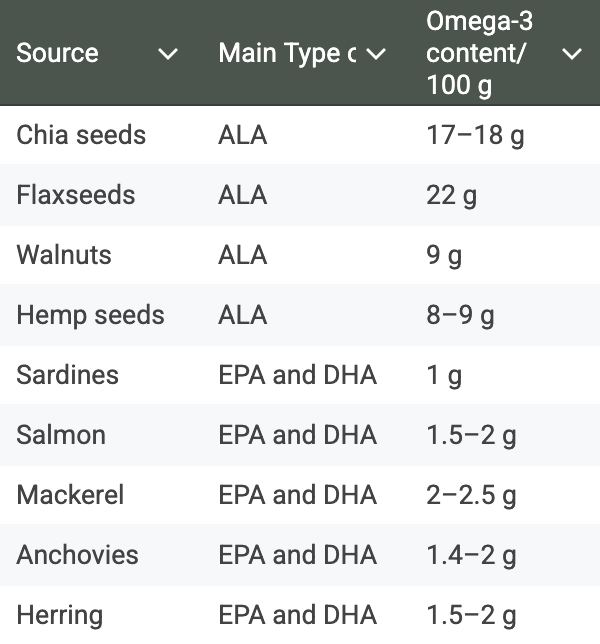
Have a look at the table to the right to find the major sources of omega 3.
At first glance, some plant foods look like the clear winners. Chia seeds, flaxseeds, walnuts, and hemp seeds all contain meaningful amounts of omega-3.
So why do nutrition scientists still keep talking about salmon, sardines, and fish oil?
Because not all omega-3 is the same.
Plant omega-3 and marine omega-3 are not identical
The omega-3 found in plants like chia, flax, walnuts, and hemp seeds is mainly called ALA, or alpha-linolenic acid. This needs to be converted in the body before we can fully benefit from it.
Fish and seafood mainly contain EPA and DHA, the forms most directly used by the body, especially in the brain, eyes, blood vessels, and immune system.
You can think of ALA as the “raw material,” while EPA and DHA are the more active forms used by the body.
The conversion challenge
Before the body can fully use plant omega-3 for many important functions, it first needs to convert it:
ALA → EPA → DHA
This conversion mainly happens in the liver. The body can absolutely convert plant omega-3, but it is not a very efficient process, and it may become even less efficient during midlife.
Roughly speaking, only about 5–10% of ALA may convert into EPA, while conversion into DHA is often below 1–5%. Sometimes even lower.
Several factors can influence conversion, including ageing, chronic inflammation, stress, insulin resistance, high omega-6 intake, and hormonal changes during midlife.
And this is important because DHA plays a particularly important role in the brain, nervous system, and eyes.
So, is chia pudding pointless?
Absolutely not.
Chia and flax remain incredibly nutritious foods. They do provide omega-3, and small amounts eaten consistently can add up over time, even with low conversion.
Additionally, they provide soluble fibre, minerals, plant compounds, satiety, and support gut health beautifully.
But biologically, they are not quite the same as eating fatty fish.
For those who do not eat fish, algae-based omega-3 supplements can be an interesting option. Algae is where fish get their omega-3 from in the first place, and algae supplements, despite originating from plants, can provide DHA and EPA directly, without relying on conversion from ALA.
These small, but important nuances matter.
In social media, nutrition conversations often become very black and white. Either a food becomes a “superfood” or suddenly useless. Reality is usually far more interesting, and a bit more complex than that.
A practical approach
So, what does this mean in everyday life?
Continue eating and enjoying plant sources like chia, flax, walnuts, and hemp seeds. Small amounts, eaten frequently, can add up to a meaningful intake over time.
If you eat fish, try including fatty fish regularly, ideally a few times per week.
If you do not eat fish, algae-based omega-3 supplements providing DHA and EPA may be worth considering.
An omega-3 supplement can be useful for some, but remember that more is not always better. Assess what you need and supplement accordingly.
Focus on consistency rather than occasional “health kicks” or megadoses. Regular intake over time appears far more important than taking large doses once in a while.
And remember: no nutrient, not even omega-3, works alone. Sleep, movement, stress, strength training, gut health, and overall dietary patterns matter just as much.
So yes, continue enjoying your chia pudding. Just perhaps not with the expectation that it does exactly the same job as salmon or sardines.
Do you have a favourite way of eating yours?
With health and happiness,
Dr. Malin Garemo
Registered Dietitian, MSc, PhD Nutrition
Scientific sources / further reading
NIH Office of Dietary Supplements. Omega-3 Fatty Acids Fact Sheet for Health Professionals.
Anderson BM, Ma DWL. Are all n-3 polyunsaturated fatty acids created equal? Lipids in Health and Disease. 2009. PMID: 19664246.
